

radu
- May 24, 2026
- |
- Headless Architecture
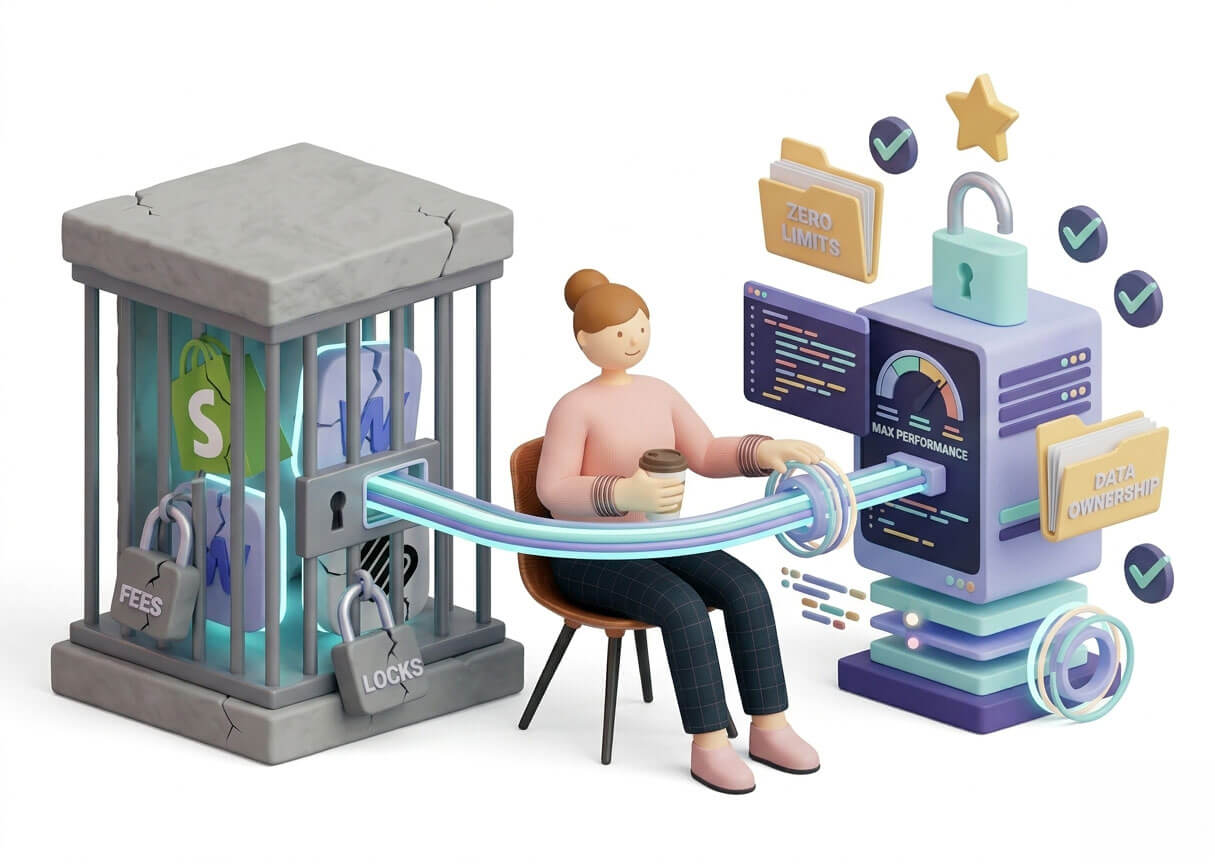
The Proprietary Trap: When SaaS Builders Become Profit Cages
It usually begins as an efficient shortcut. When launching a new digital store or enterprise web presence, all-in-one SaaS platform builders like Shopify or visual design spaces like Webflow seem like the perfect answer. They promise zero-code environments, quick template setups, and managed hosting options that remove early technical overhead.
But as your business scales, your digital requirements evolve. Eventually, you hit an invisible ceiling built into proprietary ecosystems.
You find yourself paying climbing monthly subscription costs, transaction fees on your own sales volume, and licensing fees for basic feature apps. On the design side, making significant UI/UX updates starts requiring complex workarounds because you don’t fully own your database or hosting infrastructure.
Proprietary SaaS Ecosystem (Locked):
[ Your Data & Design ] ---> [ Rigid Vendor Code Layer ] ---> [ High Monthly Fees + App Tax ]

Custom Managed Ecosystem (Free):
[ Total Data Ownership ] ---> [ Custom Open-Source CMS Backend ] ---> [ Zero Licensing / Infinite Scales ]
When your digital storefront is locked inside a closed system, you are paying a permanent premium for tools that limit your long-term growth. The solution isn’t discarding your visual branding or starting your digital presence from scratch.
By strategically migrating your existing layouts into a custom open-source backend framework, you strip away platform fees, take complete ownership of your database, and unlock endless functional scalability.
The Engineering Reality: Converting Rigid Layouts to Flexible Components
The main concern brands face when planning a platform shift is losing the design work they’ve already paid for. They assume that moving away from a tool like Webflow means completely redesigning the frontend interface.
In reality, web code is universal. The HTML, CSS styles, and structural layouts rendered by Webflow or Shopify can be extracted and systematically rebuilt into dynamic, scalable component libraries inside a custom WordPress or Headless framework.
                   ┌───> 1. Extract Pure CSS & Semantic HTML Layouts
[ Active Webflow / ]
[ Shopify Store    ] ├───> 2. Map Existing Content Structures into Database Tables
                   │
                   └───> 3. Connect Elements to a Unified, Secure Custom WordPress Core
During this engineering process, we lift the clean visual design styles out of the SaaS builder environment and map them directly onto a flexible Gutenberg block architecture or a React-based frontend engine.
Your administrative dashboard is configured to match your content strategy perfectly. Instead of dealing with clunky app code or rigid visual interfaces, your marketing team gets custom-built fields and drag-and-drop components designed specifically for your daily operational tasks.
Strategic Optimization: What You Gain After the Shift
Moving off an all-in-one visual platform to a custom engineered database provides profound performance, financial, and operational advantages.
| Operational Metric | Restricted Closed-SaaS Platforms | Reengineered Open-Source Infrastructure |
| Platform Licensing Fees | Growing monthly tier costs + App taxes | $0 (True open-source code architecture) |
| Transaction Processing | Extra percentage penalties on third-party gateways | Direct processing integration with standard merchant fees |
| Database Capability | Rigid custom field limits and static limits | Limitless database schemas & custom relational mappings |
| SEO Architecture Control | Fixed URL strings and rigid sitemap engines | Complete control over crawl maps and code semantics |
1. Eradicating the “App Tax”
On platforms like Shopify, advanced shipping configurations, custom reviews, cross-selling blocks, and translation modules require third-party app subscriptions. These recurring micro-fees quietly inflate your monthly operating overhead. In a custom backend environment, these tools are built directly into your core system software architecture—saving thousands of dollars annually.
2. Clean Semantic Code Extraction
Visual drag-and-drop builders generate automated CSS and deeply nested layout structures to render simple components. This code bloat hurts your page speeds and dilutes keyword weight for search engines. Rebuilding those interfaces by hand creates a clean, semantic document structure that speeds up page load times and maximizes your search engine crawling efficiency.
3. Unconstrained API Integrations
SaaS networks often restrict how or when you can connect external software to your system. If you need to plug in a specific enterprise ERP warehouse platform, a custom CRM data loop, or a localized fulfillment service, closed platforms require expensive middle-layer apps. An open-source custom backend gives you un-throttled code control, allowing you to connect any third-party API without ongoing platform restrictions.
The Migration Blueprint: Protecting Data and SEO Standing
A platform transition requires deep precision. Shifting large sites without an explicit technical strategy can break existing index links, damage keyword rankings, and corrupt customer transaction records.
Step 1: Secure Data Architecture Extraction
We crawl your existing database structure to safely export all past customer profiles, product variations, inventory sets, and legacy article logs into clean data sheets.
Step 2: Code Isolation & Component Engineering
We isolate your visual frontend design patterns from the underlying SaaS code layer. Our team cleans up the styling sheets and converts the layouts into highly re-usable, performant component files.
Step 3: URL Matrix Mapping & Routing Checks
We map your current site’s entire URL footprint. If any link paths change during the backend shift, we put strict server-level 301 redirect logic in place to preserve your historical search authority and prevent dead links.
Step 4: Verification, Audit & Transition
We deploy the new site to an isolated staging area to run end-to-end sandbox checkouts, forms testing, and responsive device audits. Once approved, the domain is pointed to your new independent servers with zero operational downtime.
Frequently Asked Questions
Will our team need to learn how to write code to edit the new site?
Not at all. We build the content editing experience around simple custom fields, text blocks, and structured drag-and-drop elements tailored specifically to your workflows. Your content managers will update pages, swap banners, and create new posts just as easily as before—without needing to touch raw code.
How do we handle ongoing platform updates after moving off SaaS?
When we configure your custom infrastructure, we implement robust deployment pipelines and automated staging networks. Core updates and plugin patches are systematically verified in an isolated test space before moving live, keeping your production site stable and secure.
Can we keep our exact checkout designs and payment gateways?
Yes. Your customer-facing interfaces, shopping workflows, and conversion points are completely preserved or enhanced. The only difference is operational: your data is processed through your own secure database connections rather than passing through a restrictive vendor platform.
Unlocking Digital Scaling
Staying locked inside proprietary SaaS platforms trades away long-term profit margins and custom development capabilities for a temporary lack of technical oversight. Reengineering those layouts into a managed open-source CMS gives you complete ownership of your data, infinite design flexibility, and relief from recurring app costs.
Let’s review your current platform costs, audit your active feature apps, and outline a secure, data-safe migration strategy for your digital presence.
Migration & Conversion Architecture Illustration
Here is your standalone 3D illustration for this post. It visually depicts your agency character unlocking and moving broken platform icons out of a restrictive storage vault, transferring the data streams directly into a clean, modern, and open database terminal.